


Understanding Medicare Enrollment: When and How to Enroll


Medicare enrollment timing is important because signing up in the right window helps avoid penalties and coverage gaps. Key Medicare enrollment periods include the Initial Enrollment Period around age 65, the Special Enrollment Period after qualifying life events such as losing employer coverage, the General Enrollment Period for late enrollment, the Annual Enrollment Period for changing certain Medicare or drug plans, the Medicare Advantage Open Enrollment Period, and the Medigap Open Enrollment Period for buying supplemental coverage without medical underwriting.
Understanding the different Medicare enrollment periods is crucial to avoid penalties and help ensure continuous health care coverage. This article provides a comprehensive guide to Medicare enrollment periods, eligibility requirements, necessary documentation, and strategies to understand when – and how – to enroll.
Most people become eligible for Medicare during the months around their 65th birthday, which is known as “aging in” to Medicare.
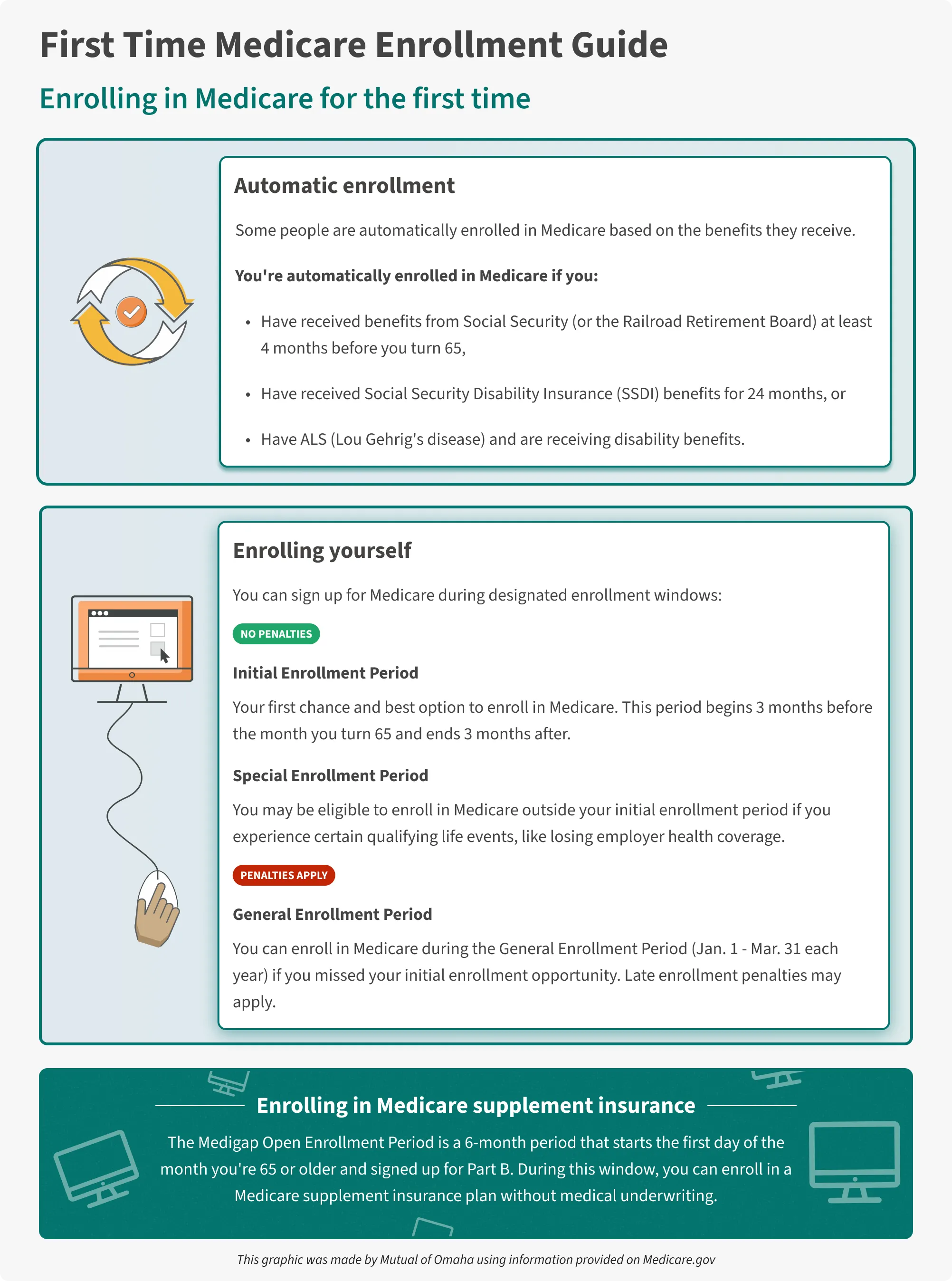
For those who are already receiving Social Security benefits, Medicare enrollment is automatic as long as they have been receiving benefits for at least four months before their 65th birthday. However, if you aren’t receiving Social Security benefits yet, you will have to enroll in Medicare during one of the available enrollment periods.
It’s important to know when your particular enrollment period is because if you don’t sign up on time, and you’re not already enrolled through Social Security, you could be charged a penalty.
Here are some important points to keep in mind regarding Medicare enrollment.
What are the different Medicare enrollment periods?
There are three distinct enrollment periods for Medicare Part A and Part B (Original Medicare). Those Medicare enrollment periods are:
the Initial Enrollment Period (IEP)
the Special Enrollment Period (SEP)
the General Enrollment Period (GEP)
Medicare Advantage plans (Part C), Medicare supplement insurance plans, and Part D prescription drug coverage, which are all provided by private insurers, have different enrollment time frames.

The Medicare Initial Enrollment Period
The Initial Enrollment Period is a seven-month time period during which you can sign up for Medicare Parts A and B. It begins three calendar months before your birthday month and continues up to three months after your birthday month.
For instance, if your birthday is in July, your Initial Enrollment Period begins April 1 and ends October 31.
Your coverage will start no sooner than your 65th birthday month unless your birthday is on the first day of the month, in which case your coverage will begin on the first day of the prior month. So, if your birthday is April 1, your coverage would start on March 1.
If you’re still working and have employer-provided coverage, then you may not need to enroll in Medicare at the time surrounding your 65th birthday month. However, you will need to enroll in Medicare within eight months of the date you no longer have that coverage in order to avoid penalties. Missing this window could result in penalties when you do enroll and potentially delay your coverage start date.
The Special Enrollment Period
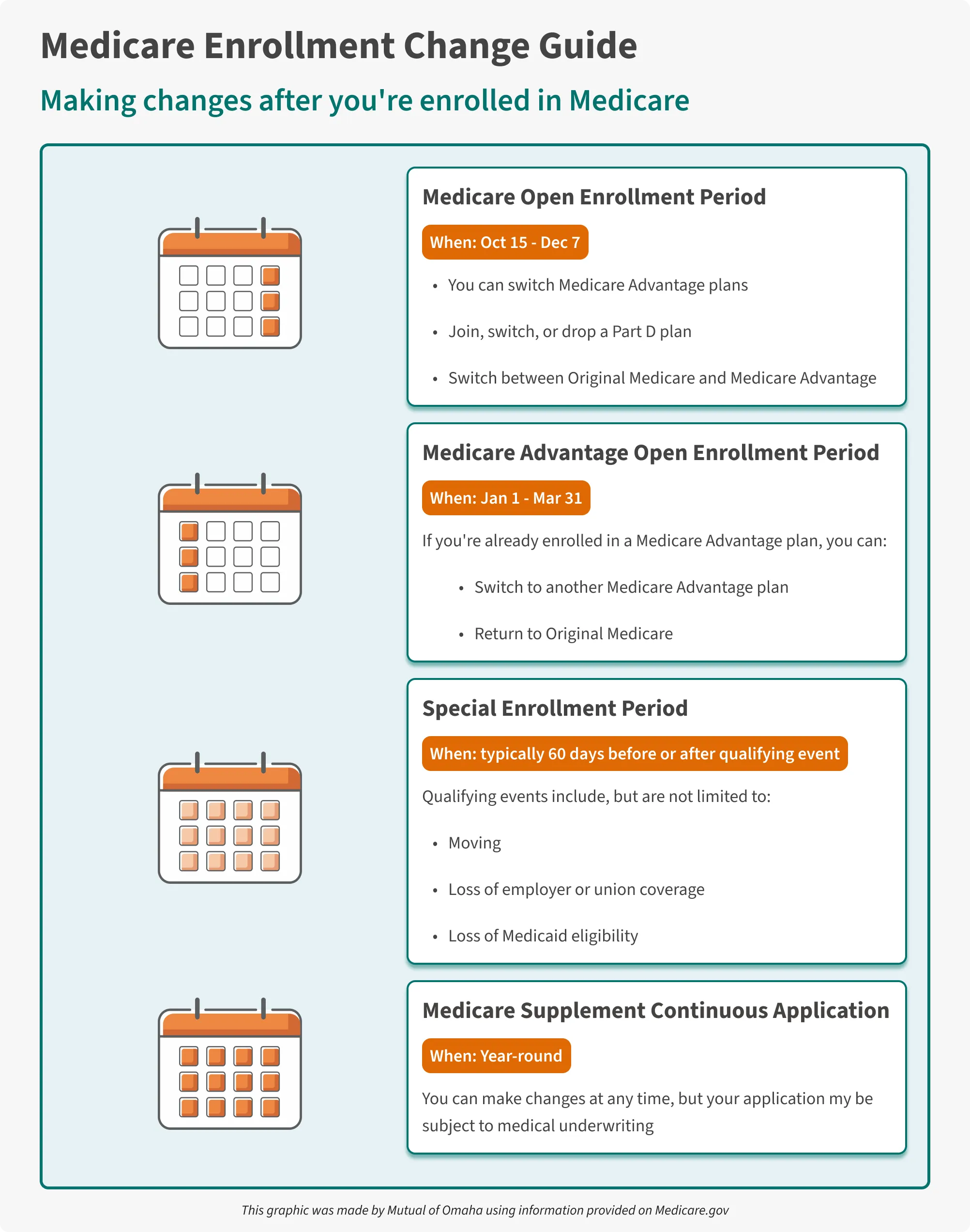
The Medicare Special Enrollment Period enables you to enroll in Medicare or make changes to your Medicare Advantage or outside the usual enrollment periods without penalties. However, you must meet certain circumstances to take advantage of a Special Enrollment Period.
Some of those circumstances include if you:
Lost employer or union coverage
Moved to a new area that affects your plan’s coverage
Are no longer eligible for Medicaid
Were released from incarceration
Moved back to the U.S. after living outside the country
Dropped your first Medicare Advantage plan within 12 months of enrolling
Dropped your first Medicare supplement plan the first time you joined a Medicare Advantage plan and are still in the “trial period” for a guaranteed issue Medicare supplement policy.
The General Enrollment Period
The General Enrollment Period (GEP) runs from January 1 to March 31 each year, offering another chance at Medicare enrollment if you missed your Initial Enrollment Period, although late penalties might apply. Coverage starts a month after your enrollment.
Medicare supplement Open Enrollment Period
While you can enroll in a Medicare supplement insurance plan at any time, the key enrollment period is within six months after the month you turn 65 and are enrolled in Medicare Part B. During this time, you have guaranteed issue rights where insurance companies can’t deny you coverage or charge higher premiums due to health conditions.6
Outside this time frame, insurers may require medical underwriting (an assessment of your current health), which may result in higher premiums or denial due to your health status. You may also face underwriting if you switch Medicare supplement plans after the open enrollment period.
Medicare supplement insurance pairs with Original Medicare Parts A and B. You cannot enroll in a Medicare supplement plan if you have Medicare Advantage, and vice versa.
Annually, Medicare offers enrollment periods to make changes to your coverage:
the Open Enrollment Period
the Medicare Advantage Open Enrollment Period

Open Enrollment Period
The Open Enrollment Period, also known as the Annual Enrollment Period, is from October 15 to December 7 every year. During this period, existing Medicare beneficiaries can make changes to their plans without penalties or being required to meet specific qualifications. For example, you can switch between Medicare Advantage and Original Medicare or alter your prescription drug coverage.
Medicare Advantage Open Enrollment Period
If you have a Medicare Advantage plan and miss the Annual Enrollment Period, you can still change your plan during the Medicare Advantage Open Enrollment Period, which runs from January 1 to March 31 each year. During this time, you can switch to a different Medicare Advantage plan, return to Original Medicare, or add a Medicare Part D prescription drug plan.
Bottom line
Whether you are approaching age 65, experiencing changes in your employment status, or adjusting to new life events, knowing your enrollment options empowers you to maintain continuous and comprehensive healthcare coverage. Taking proactive steps to enroll at the right time helps ensure you receive the benefits you’re entitled to while helping to minimize out-of-pocket costs and administrative hassles.
Frequently asked questions
Q1. How do I enroll in Social Security?
Enrollment in Social Security can be done online, by phone, or in person through the Social Security Administration. You can apply for Social Security benefits as early as age 62, but your benefits will be higher if you wait until you reach full retirement age, which is either 66 or 67 depending on the year you were born. You can receive the maximum benefit amount if you delay receiving Social Security benefits until age 70.
Q2. What if I understand when to enroll in Medicare, but don’t know what plan is right for me?
Choosing the right Medicare plan for you involves considering your healthcare needs, budget and preferred providers. At Mutual of Omaha, our online Medicare Advice Center is an excellent resource for comparing the different Medicare options to understand which plan may be right for you.
Q3. What are the requirements for Medicare enrollment?
To enroll in Original Medicare, you generally need to meet specific eligibility criteria.
You must be at least 65 years old or under 65 and have a qualifying disability or end-stage renal disease.
You should be a U.S. citizen or a legal permanent resident who has lived in the U.S. for at least five consecutive years.
Q4. What documents do I need to enroll for Medicare?
When enrolling in Medicare, you will need to provide several important documents to verify your eligibility and identity. These include your
Birth certificate or other proof of birth
Social Security card
Proof of U.S. citizenship or lawful residency if you were not born in the United States.
You may also need to provide a copy of your most recent tax returns, especially if you are applying for income-related programs. If you are already receiving Social Security or Railroad Retirement benefits, you may not need to submit these documents again.
It is also advisable to have your current health insurance information on hand to ensure a smooth transition to Medicare. Gathering these documents ahead of time can help streamline the application process and avoid delays.
Q5. Can you enroll in Medicare if you already have health insurance?
It depends on the coverage you have. If you have group health insurance through your employer, you can choose to enroll in Medicare while also retaining your employer coverage. You may also consider enrolling in premium-free Medicare Part A when you first become eligible but delaying your enrollment in Part B until after your qualifying employer coverage ends. If you have private individual coverage, such as an ACA Marketplace plan, the rules are different, and you may not be able to have both types of coverage at once.
Item #462806_0926
Suggested content for you in Medicare
-
Do All Doctors Accept Medicare?
-
Medicare Eligibility and Working Past 65
-
What Is the Difference Between Medicare and Medicaid?
-
How Does Medicare Work with Employer Insurance?
-
HSAs and Medicare: What You Need to Know
-
When is Your Medicare Enrollment Period?
-
Medicare 2026: An Introductory Guide
-
What Is the Medicare Advantage Trial Period?
-
Medicare Supplement Insurance Enrollment
-
How to sign up for Medicare Part D
Explore other topics
Financial Planning Basics
5 Holiday Budgeting Tips to Help You Save MoneyFinancial Planning Basics
How to Talk About Family Finances: 5 Tips for Better Money ConversationsEating Well
Is Keto Diet Safe for Older Adults? All Categories
 Medicare
 Retirement Planning
 Business Resources
 Life Insurance
 Financial Planning
 Health & Well-Being
 Travel & Living